September 19, 2026 · 4 min read
By the time you read the page, it's already fixed
Hand-run IT operations is finished. Here's what replaces it, and the part that still needs you.

Jeremy Martinez
Senior SRE · Incident Commander · AIOps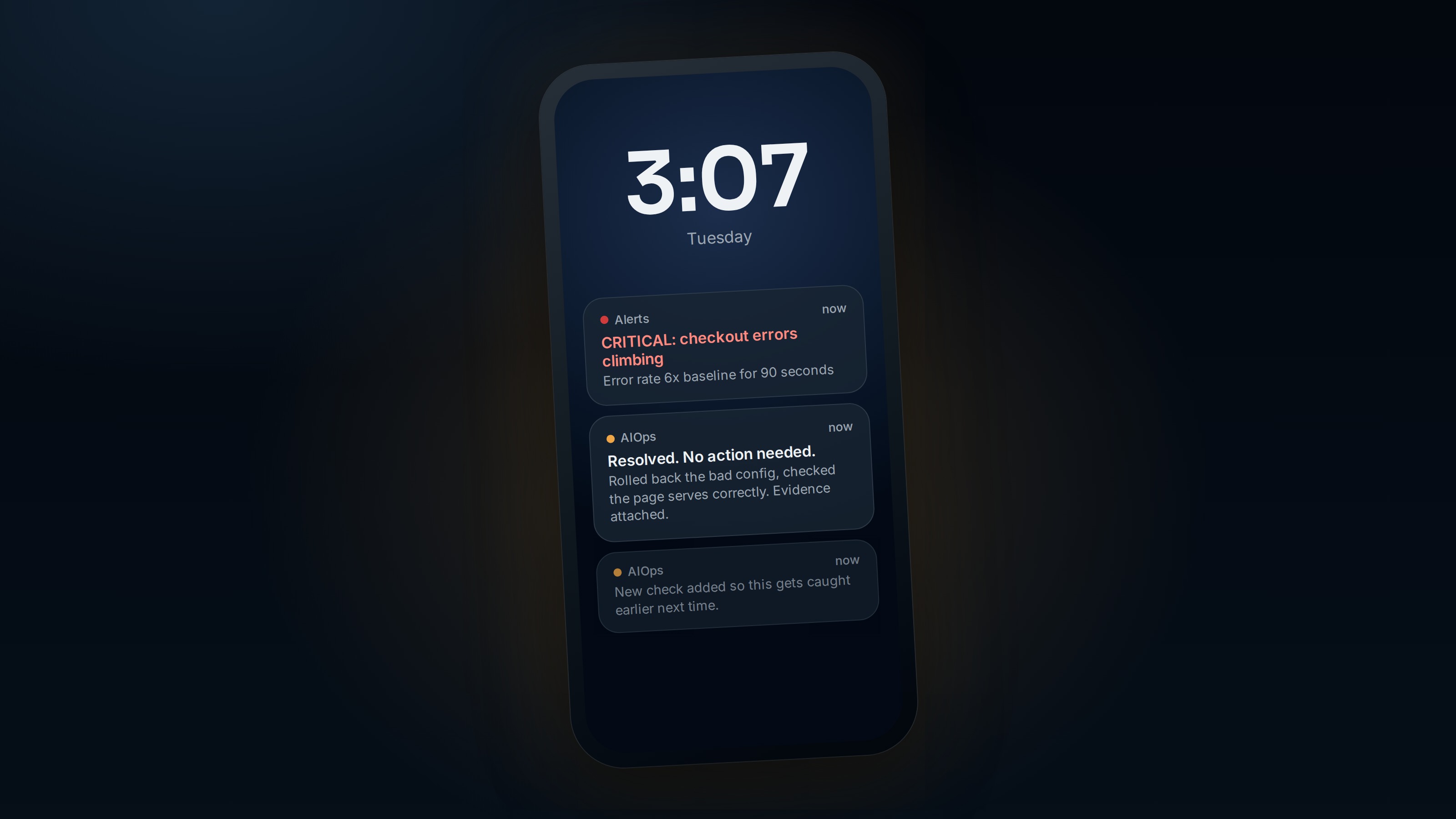
It's three in the morning and the phone is going off on the nightstand. You know the dance. Find your glasses. Squint at the alert. Open the laptop, wait for the VPN, wait for the dashboards to load, wait for your brain to load. Join the bridge. Somebody asks if it's the database. Nobody knows. So you page the DBA, and now you're both awake, and you wait while they find their glasses.
I did that for fifteen years. I did it at eBay for eleven of them, holding a 99.997% uptime SLA on a site that moved real money every second. I was good at it. I was the one they woke up.
And I'm telling you, as someone who loved that work: it's over.
The slowest thing in the building
Here's what nobody puts on the slide. In most outages I ran, the slowest component wasn't the database, the network or the code. It was us. The people. The time it took to wake a human, get them logged in, and get enough context into their head to make a decision. I've stood on bridges where the fix took four minutes and finding the person who could make it took forty.
We built whole careers around that delay. On-call rotations. Escalation policies. Runbooks written so a half-asleep engineer could follow them. A NOC desk I once ran had twelve people on it, just so somebody was always awake to read the screen.
That's the job AI does now, and it does it better than we did.
The old loop and the new one
The old loop is simple, and every step of it waits on a human. You get an alert. You investigate. You figure it out. You fix it. Then, if you're disciplined and not too tired, you write it down.
The new loop doesn't wait. The machine watches all night: every site and every server every couple of minutes, security events in near real time, and thresholds on disk, memory, certificates and tokens that fire before they turn into an outage. It takes the action it's allowed to take. It logs exactly what it saw and what it did. And it only wakes somebody up when it should.
Often, by the time your phone would have buzzed, it's handled and written up, and you find out over coffee. When it isn't, the page arrives with the evidence already attached.
That isn't a pitch deck. I run it. My own fleet runs customer websites, hosting accounts, game sites and apps, some of them holding tax and health records, and there is no night shift. The first action on an incident doesn't wait for anybody to wake up.
Let's be honest about who this replaces
AIOps isn't coming for DevOps. The people building pipelines and platforms are fine. They're the ones building this.
It's coming for IT operations as we've known it: the alert-reader, the ticket-router, the person whose job is to see a red light and follow step four of a runbook. If that's the whole job, the job is going away. Not in ten years. Now.
I don't say that to be cruel. I came up through that work. I started in the Army running a communications center, and the whole culture was operate the equipment, follow the procedure, don't panic. Those are good instincts. They're just not a job description anymore, because a machine follows the procedure faster and doesn't need coffee.
Adapt or get replaced. That's the era we're in.
What adapting actually looks like
Here's the part the hype merchants skip. A machine that can fix things at machine speed can also break things at machine speed. Hand an AI the keys to production with no limits and you haven't built automation. You've built a faster way to have a very bad night.
So the human job moves up a level. You stop being the hands. You become the person who decides what the hands are allowed to do.
On my systems, the security engine that responds to an attack by itself never writes a command. It picks from a list of actions I approved ahead of time, the list can't name a machine, and destructive actions aren't on it at all. The NOC responder gets more room, but it works from a written playbook, gets one safe try, and then hands me the evidence. Anything a customer will read waits for me. And lessons from incidents turn into checks that run every fifteen minutes and go red by themselves. There are more than eighty of them now, so we don't learn the same thing twice.
That's the new craft. Drawing the boundary. Writing the list. Reading what the machine did and deciding whether you trust it more tomorrow than you did today. It's harder than following a runbook, and it's a lot more interesting.
If someone sells you "fully autonomous operations" and can't tell you, in one breath, what their system is not allowed to do, walk out of the room.
The phone still rings
It does, sometimes. When it rings now, there's a decision on the screen that's actually mine, with the evidence already attached. Nobody needs me to go read a dashboard at three in the morning.
The rest of the night, the machine handles it. Most nights I sleep.
Fifteen years of being the one they woke up, and it turns out the best thing I ever automated was me.
Jeremy Martinez
Senior SRE · Incident Commander · AIOpsSee how it's built
The incident loop, the 34-agent org chart and what waits for a human, with diagrams. I'm open to Incident Commander, SRE and AIOps roles.