I was the bottleneck in my own AI operations
Seventy agents can get a lot done in a day. None of it moves while they wait for one person to read a question.
· 5 min read

Jeremy Martinez
Senior SRE · Incident Commander · AIOps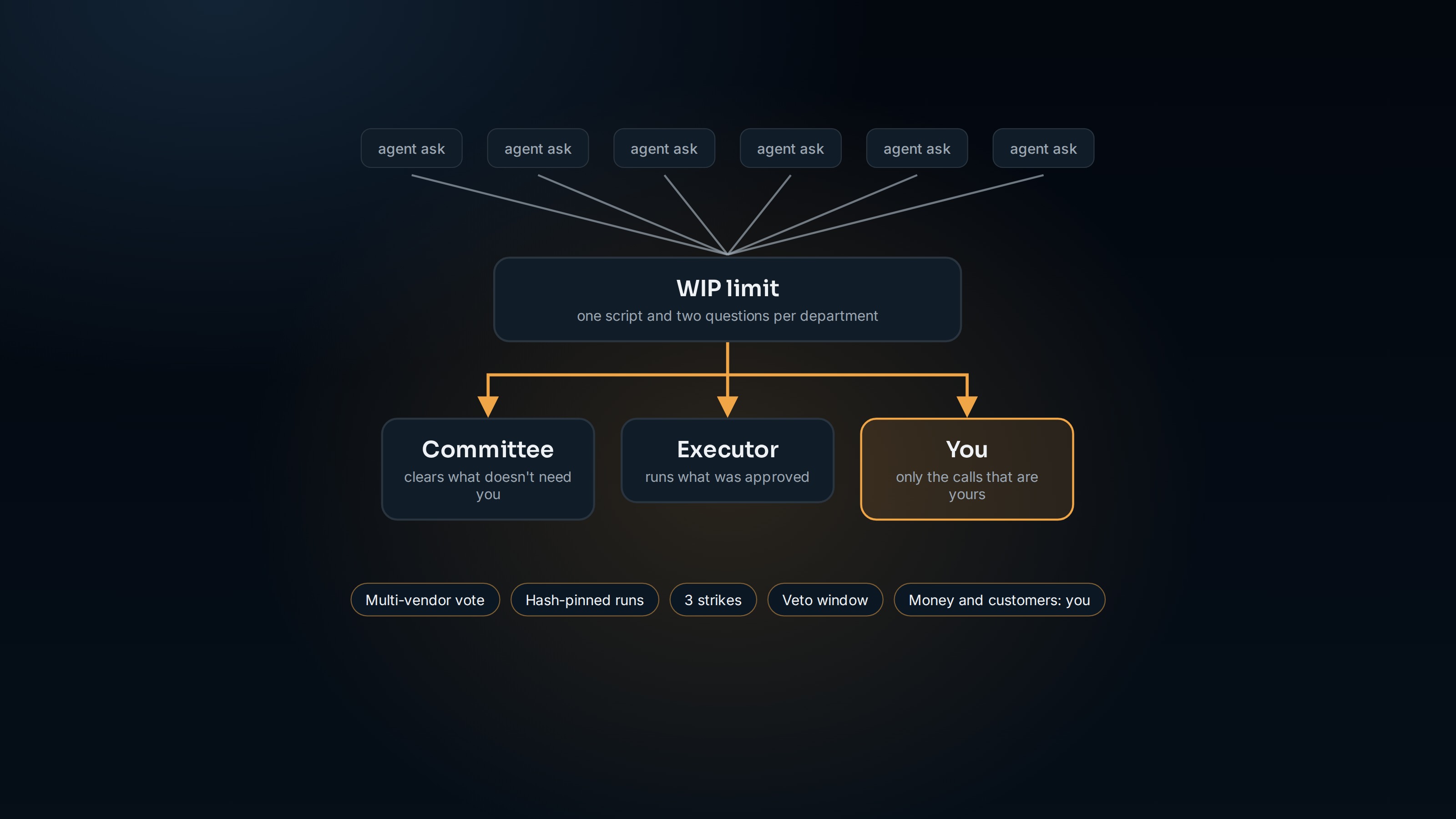
I built an org of AI agents so the first shift on an incident wouldn't wait for a person. It worked. Then I measured where the work was actually waiting, and the answer was me.
What the board said
When an agent needs a decision, it asks me on the task board: a question with options and a recommendation, or a script it has written and staged for me to run. In late October I pulled a week of those. The agents had asked me hundreds of questions that week, and a big share of them were "please run this script". My typical answer took close to two hours. Nearly half the scripts I ran by hand failed, which usually meant another question an hour or two later.
None of that was the agents misbehaving. Each question was reasonable on its own. The problem was the shape: dozens of agents working around the clock, one person, and a queue with no limit on it. It's the same shape as an on-call engineer drowning in pages, and I've spent thirty years fixing that one for other people.
Fix one: a limit on what can reach me
Each department of the org can now have one script and two questions waiting on me at a time. An ask over the limit isn't refused. It waits in a queue, and the department head picks which one goes next when a slot opens, by what it unblocks. Related asks get folded into one pack, so I answer a project once instead of six times. When too many are open across the whole company, the CEO agent's next review round is told to open no new ones, put the queue in order and tell me which to answer first.
It's a WIP limit. Kanban has had them for decades. The only new part is who sits on the other side of it.
Fix two: a committee for the stuck ones
Four times an hour, a panel of three models looks at every task that's blocked or waiting on me. One seat knows the org and who should own what, one is an expert in that task's area, and one only thinks about safety. The panel can decide, call a vote, send the task to the right team, or deny it. Anything that touches DNS or needs a one-time code comes to me whatever the panel thinks.
Here's how far it got: about two thirds of what the panel looks at still ends up with me. That's the design working. Its job is to clear what doesn't need me and say plainly why the rest does, and it answers in about half an hour where I took close to two.
Fix three: someone to run the scripts
The biggest part of my queue was scripts an agent had written and staged, waiting for me to paste them into a terminal. So the org got a new seat above the CEO, the Executor, whose only job is to carry out what the committee decides.
Every five minutes it takes a staged script and puts it to a vote by models from more than one AI vendor, and at least two thirds have to approve. On a yes it runs the script exactly the way I would: the same tool, the same hash checks, the same log, the same answer back on the task. Some things it can't do. It can't run anything that needs a secret typed in. It stops after three failed or refused tries on one task and asks why instead of trying a fourth. It can't touch the safety gates without a security sign-off on the script's exact hash and an hour for me to veto. Anything customer-facing or involving money still comes to me.
Over the last week the Executor ran more than eight of every ten scripts that used to wait for me. About a quarter of its runs fail. Nearly half of mine did, mostly because I ran them hours after they were written, against a system that had moved on in the meantime.
What it bought
Routine approvals stopped waiting for me to be awake. A fix an agent writes at 3 a.m. gets voted on, run and checked within minutes instead of sitting until I reach my desk. That's what I've been chasing my whole career: take the person out of the steps that don't need judgment, so time to recovery stops depending on who's asleep.
If you're building something like this, measure your own queue. I'd have guessed my agents were waiting on compute, on rate limits, on each other. They were waiting on me. The fix wasn't a smarter model. It was a WIP limit, a committee, and a short written list of the things only I can decide.
The AIOps page has the org chart, and the pipeline deep dive has the rest of the loop. There's also an incident review where the incident commander seat put a stopgap in place while a bigger decision waited.
Update, November 24: since this went up I've taken the next step. Asks now go to the Executor by default, and it holds my seat for them, customer email and money included. Those still pass an owner gate in code, but the Executor can hold it, every grant records who decided and how, and a veto of mine can't be overruled. What still comes to me is what only I hold: my own logins, the vault's unseal shares, the admin token, a secret I have to type. The design is in its own deep dive.
Jeremy Martinez
Senior SRE · Incident Commander · AIOpsSee how it's built
The incident loop, the agent org chart and what waits for a human, with diagrams.